You know the feeling. The teacher pauses the lesson, prayer time is slipping away, and you have to decide whether to ask to step out and pray — knowing every head in the room will turn. Or someone at school asks, half-joking, “Wait, why do you actually believe that?” and your mind goes completely blank. Or it’s late at night and you’re scrolling, watching everyone else’s life look effortless, confident, and complete, while yours feels like the opposite.
If any of that sounds familiar, you are not weak and you are not alone. Almost every young Muslim wrestles with confidence at some point. The encouraging truth is that confidence is not a fixed trait you either have or don’t. It can be built — and Islam gives you one of the strongest foundations to build it on.
Allah says in the Quran:
“So do not weaken and do not grieve, and you will be superior if you are [true] believers.” — Surah Aal-Imran 3:139 (Sahih International)
Read that slowly. Allah is not telling you to fake being strong. He is telling you that real strength is a natural result of faith. When your heart is connected to Him, you have something to stand on that the opinions of a classroom can never shake. This article is about how to build that kind of confidence — and to bring it to life, we’ll follow the story of a young man who lived it completely: Mus’ab ibn Umayr.
What Confidence as a Muslim Youth Really Means
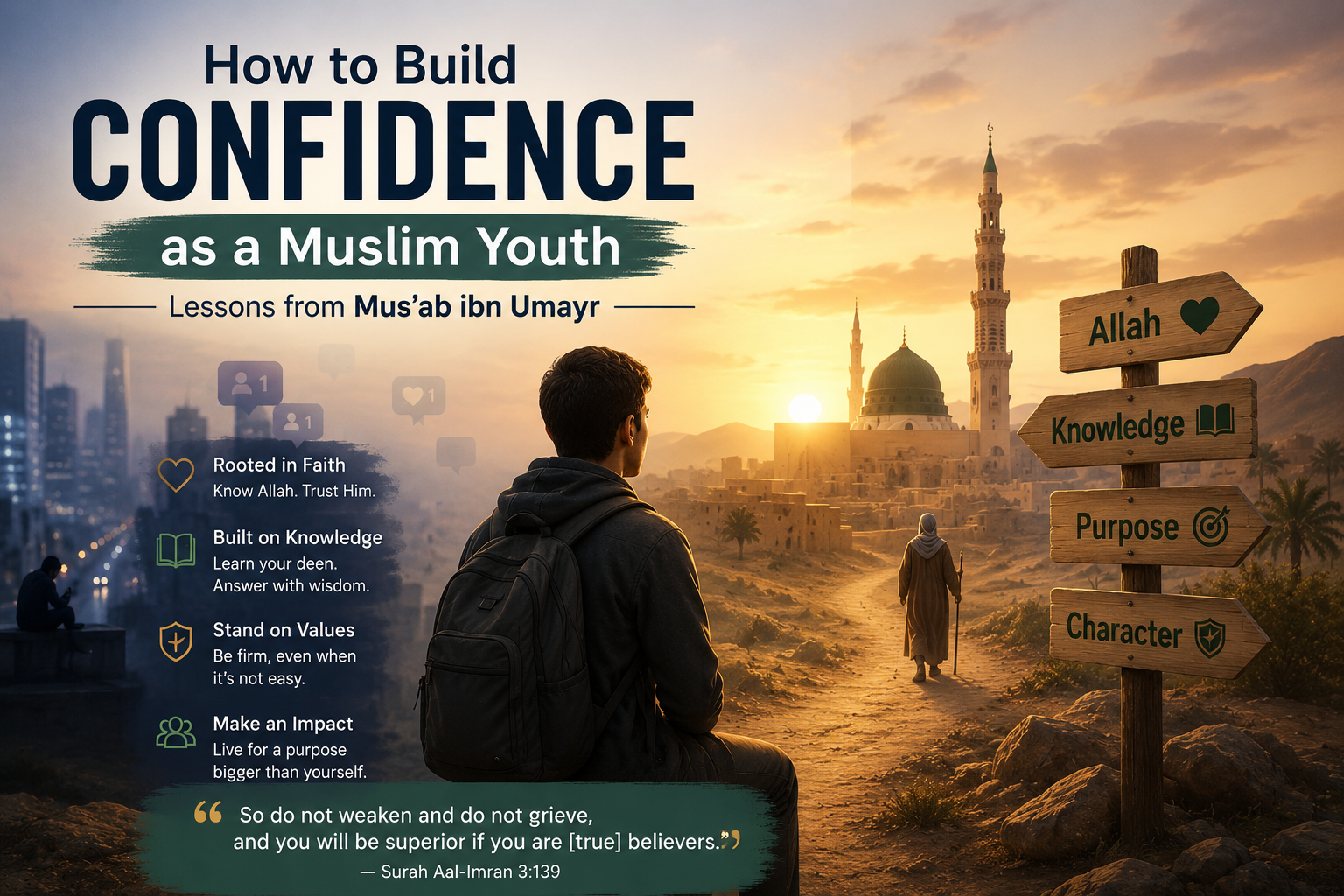
Before we go further, it’s worth being clear about what confidence actually is. Confidence is not about being loud, popular, or always certain of yourself. In Islam, confidence means trusting Allah enough to do what is right even when it is difficult. It’s the quiet strength to pray when you’d rather hide it, to speak the truth when silence would be easier, and to hold onto your values when everyone around you is letting go of theirs. That is the kind of confidence we’re talking about — and it’s exactly the kind Mus’ab ibn Umayr had.
The most admired young man in Makkah
Picture the most envied teenager in your city. Now go back fourteen centuries to Makkah, and that was Mus’ab ibn Umayr.
He came from one of the wealthiest and most respected families of the Quraysh, from the clan of Banu Abd al-Dar. He grew up wrapped in comfort that ordinary people could only dream of. He was strikingly handsome, dressed in the finest clothes, and admired everywhere he went. People described him as one of the most charming young men in all of Makkah. He even earned the nickname al-Khayr — “the Good.”
In today’s terms, Mus’ab had it all: the looks, the money, the status, the followers, the approval of everyone around him. If confidence really came from those things, he should have been the most confident person alive.
But here is the quiet lesson buried in his story. Every bit of that admiration was borrowed. It depended entirely on what other people thought of him. And the day he chose the truth, all of it was stripped away — almost overnight.
When he chose faith over approval
When Mus’ab heard the message of the Prophet Muhammad (peace be upon him), something stirred in him that all his wealth had never reached. He embraced Islam as a young man, in the earliest and most dangerous days of the religion, when becoming a Muslim could cost you everything.
He tried to keep his faith hidden, because he understood the price. But Makkah kept no secrets for long. When his family discovered he had become a Muslim, his world turned upside down. The young man who had been pampered his entire life was confronted by his own family, and his mother confined him to the house to force him to abandon his belief.
He refused.
Sit with that for a moment. Mus’ab — the one used to silk, comfort, and constant praise — gave up his family’s wealth, his status, and the easy life he had always known, rather than give up his faith in Allah. Eventually he escaped and migrated with other persecuted Muslims to Abyssinia, leaving behind everything the world had taught him to value.
This is the turning point that matters for anyone struggling with confidence today. Mus’ab’s entire sense of worth had always come from outside himself — from looks, money, and the approval of the crowd. The moment he chose Islam, all of it collapsed. And what he discovered in its place was something far stronger and far more lasting.
The confidence the world sells you — and why it breaks
Think about where most young people are told to find confidence today. It comes from appearance — the right look, the right body, the right photo. It comes from popularity — followers, likes, being in the right group. It comes from grades, achievements, and being noticed.
None of these things are evil in themselves. The problem is what happens when you build your confidence on them. Anything built on the opinions of others can be taken away by the opinions of others. One harsh comment, one failure, one shift in your friend group, and the whole thing wobbles. That is exactly what happened to Mus’ab’s old life the instant he chose faith — the admiration of an entire city vanished.
Social media makes this worse than ever. You are not comparing your real life to other people’s real lives. You are comparing your behind-the-scenes to their highlight reel. It is a competition you can never win, because it isn’t real.
Where real confidence in Islam comes from
Islamic confidence works on a completely different foundation. It does not rest on what people think of you. It rests on three things no one can take away:
Knowing Allah. When you understand that you are created, known, and loved by Allah — that He is aware of you even when no one else is — your worth stops depending on the crowd.
Knowing your purpose. You are not here by accident, and you are not here to collect likes. You exist to worship Allah and to do good. That sense of purpose steadies you when everything around you feels shaky.
Knowing your values. When you are clear on what you believe and why, you no longer need everyone’s approval to feel okay. You can stand calmly on your own ground.
This is the confidence Mus’ab found. He lost the admiration of a whole city and gained something that imprisonment, exile, and hardship could never touch.
From pampered youth to the first ambassador of Islam
What Mus’ab did next shows just how far faith-based confidence can carry a person.
After a group from the city of Yathrib (later Madinah) pledged their loyalty to the Prophet (peace be upon him), the Prophet needed someone to travel there, teach its people the Quran, and prepare the city for the future of Islam. Out of all the companions, he chose Mus’ab ibn Umayr.
Think about the weight of that. A young man, not long a Muslim, was sent alone as the first ambassador and teacher of Islam to an entire city. Through his patience, his character, and his teaching, many of Madinah’s leading figures accepted Islam at his hands. The same young man once known only for his fine clothes was now trusted with one of the most important missions in early Islamic history.
That is what confidence rooted in faith makes possible. It is never loud or arrogant. It is the quiet steadiness that lets a person carry real responsibility.
Knowledge: the antidote to insecurity
Notice why Mus’ab was chosen as a teacher. It was because he had learned. His confidence in front of the people of Madinah was not bluffing — it came from genuinely knowing the Quran and the teachings of Islam well enough to share them.
There is a direct lesson here for you. A huge part of teenage insecurity, especially when you are the only Muslim in the room, comes from not knowing how to answer. Someone challenges your beliefs and you freeze — not because Islam has no answer, but because you don’t yet know it. That silence then gets misread, by you most of all, as weakness.
Knowledge changes that. Picture three common moments:
Someone asks you a question about Islam. Instead of panicking, you calmly explain what you actually believe, because you’ve taken the time to learn it. You don’t need to win an argument — you just need to know your own ground.
You face peer pressure to do something against your values. Because you understand why Islam guides you the way it does, “no” comes from conviction, not fear. That is a quiet, powerful kind of confidence.
Someone challenges or mocks your faith. Instead of getting flustered or angry, you stay calm, because your sense of self isn’t on trial — it rests with Allah.
Every hour you spend learning your deen quietly removes a source of anxiety. The Prophet (peace be upon him) himself pointed to the value of strength in the believer:
“The strong believer is better and more beloved to Allah than the weak believer, though there is good in both.” — Sahih Muslim 2664
Scholars have explained that this strength includes strength of faith, character, and resolve — not just the body. To strengthen your knowledge and your iman is to become exactly the kind of believer this hadith describes.
True to the end
Mus’ab ibn Umayr carried the banner of the Muslims at the Battle of Uhud, and there he was martyred in the year 625 CE.
He died with almost nothing of this world — the very same young man who had once been the best-dressed person in Makkah. And yet, more than fourteen centuries later, he is remembered, honoured, and loved, while the admiration he once chased is long forgotten. That is the difference between borrowed confidence and the real thing.
Five steps to build real confidence
Confidence grows through action, not just reflection. And Allah has tied change to our own effort. He says:
“Indeed, Allah will not change the condition of a people until they change what is in themselves.” — Surah Ar-Ra’d 13:11 (Sahih International)
This verse is the heart of how to build confidence as a Muslim: Allah opens the door, but you have to take the first step. Real Muslim youth confidence is built through small, consistent actions like these five.
1. Anchor your day with Salah. Pray your five daily prayers on time as best you can. These are five fixed moments to reconnect with Allah and reset your heart. Start by guarding just one prayer perfectly — for example, never missing Fajr — and build from there. Nothing steadies confidence like knowing you have a daily appointment with your Lord.
2. Learn one thing about Islam each week. Pick a single topic — the meaning of Surah Al-Fatiha, one event from the life of the Prophet (peace be upon him), or the reason behind a practice you’ve always done without thinking. Learn it properly from a reliable source. Knowledge turns “I don’t know what to say” into calm certainty, exactly as it did for Mus’ab.
3. Limit the comparison feed. Notice which accounts leave you feeling worse about yourself, and mute or unfollow them. Set a daily limit on the apps that pull you into comparison. Protecting your input protects your peace.
4. Do one small brave thing. Confidence is a muscle. Speak up once in class when you’d normally stay silent. Pray in public when it would be easier to skip it. Answer that question about Islam instead of changing the subject. Each small act of courage makes the next one easier.
5. Choose your company carefully. The people around you set the temperature of your self-belief. Seek friends who remind you of Allah and encourage your growth, and spend less time with those who feed your doubts. Good companionship is one of the strongest protectors of a confident heart.
A dua for confidence
Two short supplications are worth memorising and repeating. The first is from the Quran, which the Prophet (peace be upon him) was taught to say:
رَّبِّ زِدْنِي عِلْمًا “My Lord, increase me in knowledge.” — Surah Ta-Ha 20:114 (Sahih International)
The second is a dua the Prophet (peace be upon him) said often, asking Allah to keep the heart firm:
يَا مُقَلِّبَ الْقُلُوبِ ثَبِّتْ قَلْبِي عَلَى دِينِكَ “O Turner of the hearts, keep my heart firm upon Your religion.” — Narrated by Umm Salamah; Sunan al-Tirmidhi (graded hasan)
Knowledge and a steady heart are exactly what confidence is built from. Ask Allah for both.
What confidence is NOT
It’s just as important to understand what real confidence is not. Confidence in Islam is not:
Being loud or showing off to get attention
Arrogance — thinking you are better than other people
Looking down on others or treating them as less than you
Believing you are always right, or refusing to admit when you are wrong
In fact, true confidence is the opposite of arrogance. It comes from humility before Allah and certainty in the values He has given you. The Prophet Muhammad (peace be upon him) — the most confident human being who ever lived — was also the most humble. He could stand before powerful enemies without fear, and yet sit with the poorest people without pride. That is the balance to aim for: confidence that lifts you up without needing to push anyone else down.
The takeaway
Mus’ab ibn Umayr was a young person, just like you. The confidence that made him one of the most important figures in early Islam did not come from being admired, wealthy, or good-looking — he had all of that and walked away from it. It came from knowing Allah.
That same confidence is available to you. Build it through your prayer, your knowledge, your courage, and your company, and it will hold you steady when everything around you tries to shake it.
Because in the end, real confidence is not believing you are better than everyone else.
Real confidence is knowing who you are before Allah.
Explore more in our Youth Leadership section.
Sources
Quran quotations are cited by surah and verse number, using the Sahih International translation. Historical details regarding Mus’ab ibn Umayr are drawn from classical seerah sources, including the accounts preserved by Ibn Hisham and Ibn Kathir. Hadith references: Sahih Muslim 2664; Sunan al-Tirmidhi (the dua “O Turner of the hearts,” narrated by Umm Salamah, graded hasan).