Be honest for a second. When you hear the word “knowledge,” what comes to mind? Probably exams, textbooks, and stress. Something you’re forced to do, then forget the moment the test is over. For a lot of young Muslims, “seeking knowledge” sounds like just another chore piled on top of school.
But what if you found out that learning — real learning about your faith and your world — isn’t optional in Islam at all? That it’s not a suggestion or a nice extra, but an actual obligation, commanded by the Prophet Muhammad (peace be upon him) himself? And what if the greatest example of it wasn’t a rich genius with every advantage, but a poor, orphaned man who arrived late, owned almost nothing, and changed Islamic history through nothing but determination?
That man was Abu Hurairah. His story is about to change how you see learning forever.
Why seeking knowledge in Islam matters
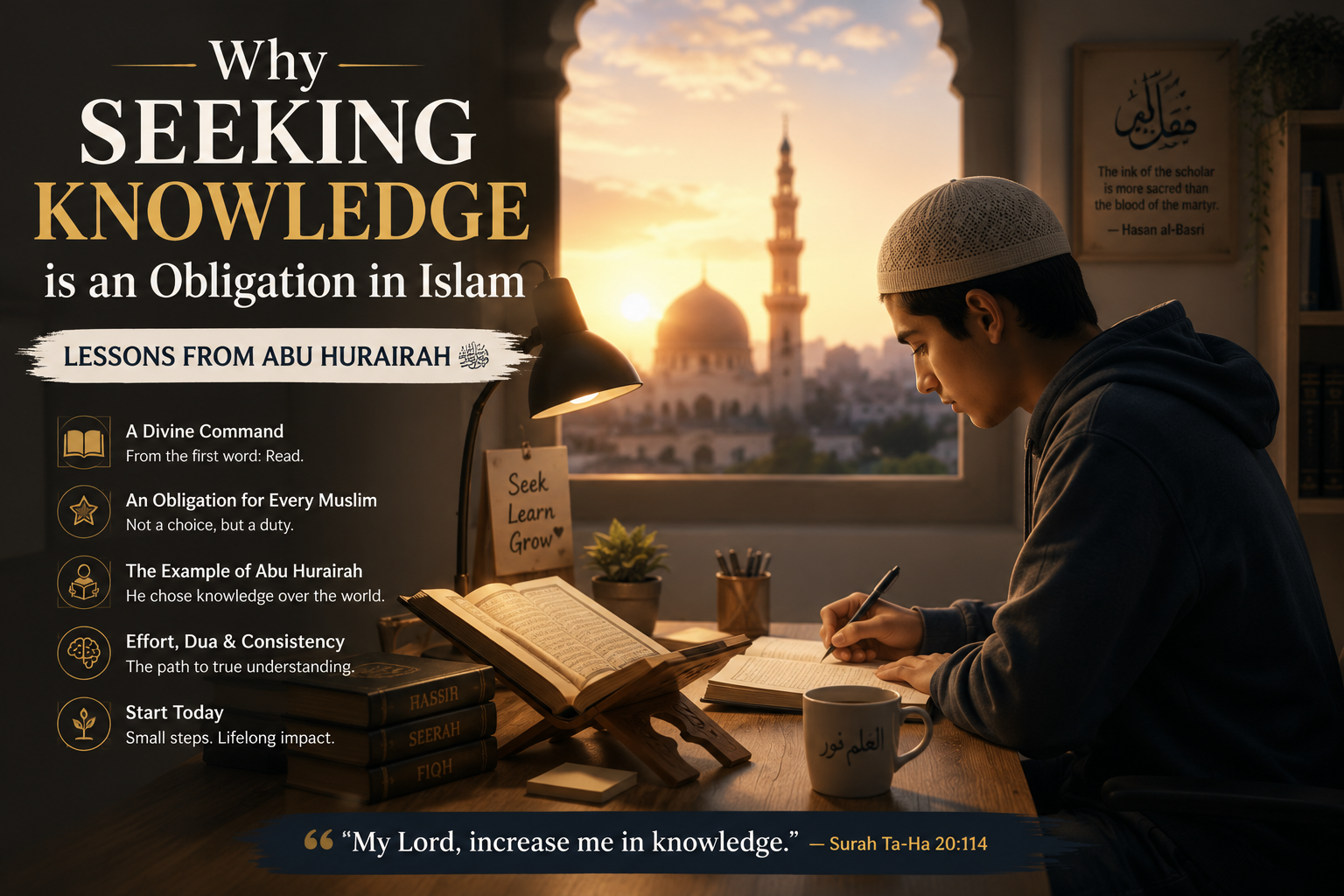
Here is something remarkable. The very first word ever revealed of the Quran to the Prophet Muhammad (peace be upon him) was a command to learn: “Read.” Before any law, before any ritual, the message of Islam opened with an instruction to seek knowledge.
The Quran returns to this theme again and again, and one verse puts it as plainly as possible:
“Say, ‘Are those who know equal to those who do not know?’ Only they will remember [who are] people of understanding.” — Surah Az-Zumar 39:9 (Sahih International)
It’s a rhetorical question with an obvious answer. No — the one who knows and the one who doesn’t are not the same. Islam places the person who learns on a completely different level. Knowledge isn’t decoration in this religion. It’s the foundation of everything else.
It is not a suggestion — it is an obligation
Plenty of religions and cultures encourage learning. Islam goes further. The Prophet Muhammad (peace be upon him) made it a duty:
“Seeking knowledge is an obligation upon every Muslim.” — Sunan Ibn Majah 224 (narrated by Anas ibn Malik, graded authentic by Al-Albani)
Read those words carefully. Not “every scholar.” Not “every man.” Every Muslim — young and old, male and female, rich and poor. Scholars explain that this obligation covers, at minimum, the knowledge you need to practise your faith correctly: how to pray, how to purify yourself, the basics of belief, what is halal and haram in your daily life. Learning these things is not optional any more than the prayer itself is optional.
That single sentence shaped Muslim civilisation for fourteen centuries. It built libraries, universities, and study circles from one end of the world to the other. And it applies to you, today, just as much as it applied to the companions who first heard it.
The poorest student in Madinah
Now meet the man who took this obligation more seriously than almost anyone.
Abu Hurairah came to Islam with nothing. He was poor, he had lost his father young, and he arrived in Madinah only in the later years of the Prophet’s life — meaning he spent far less time with the Prophet (peace be upon him) than the senior companions did. By every worldly measure, he was the least likely person to become a giant of Islamic knowledge.
He had no wealth, no status, no head start. What he had was a decision: to give everything he had to learning directly from the Messenger of Allah (peace be upon him).
How he out-learned everyone
Here is the part that should stop every young Muslim in their tracks. Abu Hurairah explained his own secret in his own words. He said that while the emigrants were busy trading in the markets and the helpers of Madinah were busy looking after their farms and property, he chose differently. He stuck close to the Prophet (peace be upon him), content with just enough food to fill his stomach, so that he could be present for what others missed and memorise what others did not. (Sahih al-Bukhari)
Think about what that means. Abu Hurairah was not smarter than the other companions. He was not richer — he was far poorer. His advantage was simple: he showed up, consistently, and gave learning his full attention while others were distracted by the demands of daily life.
He made a trade most people are not willing to make. He accepted less of the world in exchange for more knowledge. And it paid off beyond anything he could have imagined — Abu Hurairah went on to become the single most prolific narrator of the Prophet’s sayings in all of Islamic history. Much of what Muslims know today about how the Prophet (peace be upon him) lived, prayed, and taught comes through this one poor man who simply refused to be distracted.
Abu Hurairah was not the richest companion, the oldest, or the longest at the Prophet’s side. He simply refused to stop learning.
Even his memory came through effort and dua
You might think, “Well, he must have had a perfect memory.” But even that came after struggle — and after he asked Allah for help.
Abu Hurairah once complained to the Prophet (peace be upon him) that he was hearing many narrations but forgetting them. The Prophet told him to spread out his garment. Abu Hurairah did, the Prophet made a gesture as if placing something into it and told him to wrap it around himself — and from that day, Abu Hurairah said, he never forgot anything again. (Sahih al-Bukhari 3648)
The lesson here is not that we should expect a miracle. The lesson is the order of events: Abu Hurairah was already putting in maximum effort, attending every gathering and trying his hardest to retain what he heard. Then he brought his struggle to Allah and asked for help. Effort first, then dua. That is the pattern for any student.
Why this matters for you right now
It is easy to read about a companion from fourteen centuries ago and feel the distance. So let’s make this concrete. Abu Hurairah’s story speaks directly to the excuses young Muslims make today:
“I’m not smart enough.” Abu Hurairah wasn’t the cleverest companion. He was the most consistent. Consistency beats talent.
“I don’t have time.” Everyone around Abu Hurairah was busier than him with trade and property — and he was the one who learned the most, precisely because he protected his time for knowledge.
“I don’t have the resources.” He was one of the poorest people in Madinah. He owned almost nothing. Knowledge cost him attention and effort, not money.
“Where would I even start?” He started by simply showing up to one teacher, consistently, and refusing to be distracted. You can start with one reliable source and fifteen honest minutes a day.
The obstacles you think are stopping you from learning your deen are the exact same obstacles Abu Hurairah faced — and overcame.
Five steps to start seeking knowledge today
Knowledge is built through consistent action. Here are five specific ways to begin.
1. Learn the “obligatory minimum” first. Start with what you need to practise Islam correctly: how to pray properly, how to make wudu, and the basics of your belief. This is the knowledge the hadith makes a personal duty. Master it before anything else.
2. Commit to fifteen minutes a day. Abu Hurairah’s secret was consistency, not intensity. Fifteen focused minutes every day will teach you more in a year than occasional long bursts. Pick a fixed time — after Fajr, before bed — and protect it.
3. Choose one reliable source. Don’t drown in random clips and conflicting opinions online. Find one trustworthy teacher, book, or structured course and stick with it long enough to actually build understanding. Our Islamic Knowledge section is a good place to begin if you’re not sure where to start.
4. Protect your attention. Abu Hurairah learned the most because he stayed present while others were distracted. Your version of the marketplace is your phone. Put it away during your learning time and give your full attention, the way he gave his.
5. Make effort, then make dua. Study hard first, then ask Allah to help you understand and remember — exactly the order Abu Hurairah followed.
A dua for knowledge
The Prophet Muhammad (peace be upon him) was himself commanded in the Quran to ask for more knowledge — a powerful sign of how central learning is in Islam:
رَّبِّ زِدْنِي عِلْمًا “My Lord, increase me in knowledge.” — Surah Ta-Ha 20:114 (Sahih International)
Make this short dua part of your daily routine, especially before you study. If the Prophet (peace be upon him) was told to ask for more knowledge, then so should we.
What seeking knowledge is NOT
It’s important to be clear about what this obligation does not mean. Seeking knowledge in Islam is not:
- Only for “religious” people — it is a duty on every single Muslim, not just imams and scholars
- About showing off — the Prophet (peace be upon him) warned against learning in order to impress people or win arguments
- Limited to memorising facts — real knowledge is meant to be understood and acted upon, not just collected
- Reserved for the gifted or wealthy — Abu Hurairah, poor and arriving late, proved that dedication matters more than advantage
True knowledge in Islam is learning that brings you closer to Allah and changes how you live. Knowledge that stays in the head but never reaches the heart or the hands has missed its purpose.
The takeaway
Abu Hurairah had every excuse not to learn. He was poor, orphaned, and late to Islam, surrounded by people with more time, more money, and more standing than he had. He could have decided that knowledge was for other people.
Instead, he made a choice: to show up, stay consistent, protect his attention, and give learning everything he had. That single decision turned the poorest student in Madinah into one of the most important transmitters of Islam in history.
You face smaller versions of the same obstacles, and you have the same choice in front of you. Seeking knowledge is not a burden placed on you — it is an obligation that lifts you, an open door that Islam commands you to walk through.
Because in Islam, the one who knows and the one who does not know are simply not the same.
Begin today
The next year of your life will pass whether you learn or not. The question is who you will become by the end of it.
Abu Hurairah began with almost nothing but sincerity and determination. Yet through consistent effort, Allah made him one of the most influential teachers in Islamic history. He did not get there in a day, and neither will you — knowledge grows the way he grew it, one gathering and one small step at a time.
You do not need to know everything today. You simply need to begin.
Open a book. Attend a lesson. Learn one verse. Understand one hadith. Take one step.
And ask Allah:
رَّبِّ زِدْنِي عِلْمًا “My Lord, increase me in knowledge.” — Surah Ta-Ha 20:114 (Sahih International)
Sources
Quran quotations are cited by surah and verse number, using the Sahih International translation. Historical details regarding Abu Hurairah are drawn from authentic narrations, including his own account preserved in Sahih al-Bukhari. Hadith references: Sunan Ibn Majah 224 (narrated by Anas ibn Malik, graded authentic by Al-Albani); Sahih al-Bukhari 3648 (the narration concerning Abu Hurairah’s memory).