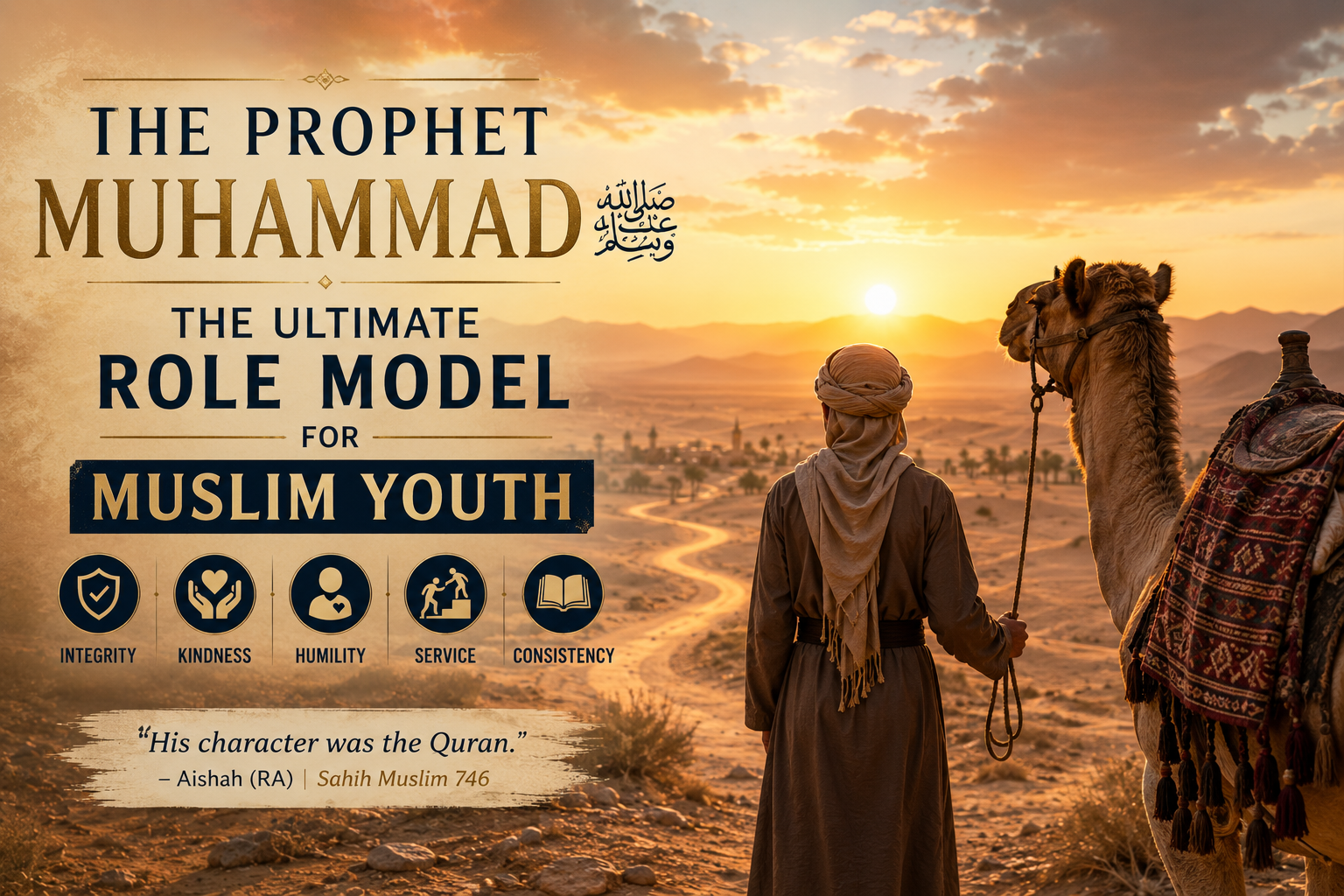
Every young person is following someone. Whether you notice it or not, you are being shaped — by the influencers on your feed, the celebrities you admire, the friends whose approval you want. We copy how they talk, how they dress, what they value, what they laugh at. The question is never whether you have a role model. The question is who—and in Islam, the answer is clear: the Prophet Muhammad role model that every young Muslim should follow.
And here is the problem. Most of the people young Muslims are handed as role models today are famous for things that fade — looks, money, fame, a viral moment. Strip those away and there is often very little underneath. Many of them, if you met the real person behind the image, would disappoint you.
There is one exception – Prophet Muhammad ﷺ role model whose character was so complete that Allah Himself praised it, whose example has guided Muslims across every generation, and who is a role model not just for scholars or adults, but specifically and beautifully for the young: the Prophet Muhammad (peace be upon him).
A role model chosen by Allah Himself
We do not have to guess whether the Prophet (peace be upon him) is a good example to follow. Allah states it directly in the Quran:
“There has certainly been for you in the Messenger of Allah an excellent pattern for anyone whose hope is in Allah and the Last Day and [who] remembers Allah often.”
— Surah Al-Ahzab 33:21 (Sahih International)
Think about how remarkable that is. The Creator of the universe points to one man and says, in effect: here is your example. Not a suggestion, not one option among many — the pattern to follow. And Allah described his character in words that apply to no one else:
“And indeed, you are of a great moral character.”
— Surah Al-Qalam 68:4 (Sahih International)
When his wife Aishah (may Allah be pleased with her) was later asked what the Prophet (peace be upon him) was like, she summed up his entire character in a single, stunning sentence: “His character was the Quran” (Sahih Muslim 746). In other words, he didn’t just teach the message — he lived every part of it. If you want to know what the Quran looks like in a human being, you look at him.
Trustworthy before he was even a Prophet
Here is something many young Muslims don’t realise. The Prophet (peace be upon him) earned his community’s deepest respect before he ever received revelation — through his character alone.
Long before prophethood, the people of Makkah gave him a title: Al-Amin, “the Trustworthy.” This is well established in the standard biographies of his life, such as the Seerah of Ibn Hisham. In a society full of rivalries, tribal pride, and dishonesty, he was so widely trusted that people would leave their belongings in his safekeeping — a reputation so strong that it held even among those who later opposed his message.
Sit with what that means. He didn’t become admirable because he became a Prophet. He was already widely known for his honesty and trustworthiness — as a young man, through his conduct. That reputation was built the same way yours is: one honest action, one kept promise, one trustworthy moment at a time.
This is the first lesson for any young Muslim. Your character is your real reputation. Not your followers, not your image — the person you actually are when people rely on you.
Why good character matters so much in Islam
There is a hadith that captures the heart of why the Prophet (peace be upon him) was sent, and it should reshape how every young Muslim thinks about being a “good Muslim.” He said:
“I was sent to perfect good character.”
— Narrated by Abu Hurairah (Al-Adab Al-Mufrad 273)
This hadith shows how central good character is to the Prophetic message. Worship and character are not separate parts of Islam. Sincere worship is meant to shape how we speak, how we treat others, how we keep our promises, how we respond to anger, and how we carry responsibility. Prayer, fasting, and devotion are the foundation — and beautiful character is the fruit they are meant to produce. A person whose worship never softens their behaviour has missed something essential about what that worship is for.
A scene from his life: the boy who served him for ten years
It is one thing to list a person’s qualities. It is another to watch those qualities in action. So here is a real scene — one of the most moving in all of the hadith literature — narrated by a young man who saw the Prophet (peace be upon him) up close, every single day, for a decade.
Anas ibn Malik began serving the Prophet (peace be upon him) as a boy of around ten and stayed in his service for ten years. Think about that: ten years living and working alongside someone, through good days and hard ones. Anyone who has been served by another person knows how easily impatience slips out — a sharp word, a “why did you do that?”, a sigh of frustration. Now listen to what Anas said about those ten years:
“I served the Prophet for ten years, and he never said to me ‘Uff’ (a word of irritation), and never said about anything I did, ‘Why did you do that?’ or about anything I did not do, ‘Why did you not do that?'”
— Sahih al-Bukhari 6038, Sahih Muslim 2309
Ten years. Not one harsh word. This was the most important man in Madinah, and he treated a young servant with a gentleness that most people cannot manage for ten days. That is not weakness — it is extraordinary strength of character. And it is the clearest possible answer to anyone who thinks power means being harsh, or that leadership means looking down on those who serve you.
Leadership through service, not status
When you picture a powerful leader, you probably imagine someone who sits above everyone, gives orders, and is served by others. The Prophet (peace be upon him) turned that image completely upside down.
He led the greatest transformation in Arabian history, yet he lived simply and never used his authority to place himself above the people. As we just saw with Anas, he was gentle with the young. He was patient with those who made mistakes and merciful even to those who had wronged him. The most respected man of his time carried himself with humility, not arrogance.
This is the model of leadership Islam gives young people, and it is radically different from what the world sells. Real leadership is not about being above people — it is about serving them, lifting them, and being trusted by them. Strength with humility: that is the exact balance every young Muslim leader should aim for.
Why the Prophet Muhammad is the perfect role model for youth
You might wonder whether a man from long ago can really be a model for a young Muslim navigating school, friendships, and phones. He can — precisely because he modelled the things that never change. Here is what following his example looks like in a young person’s actual life:
Integrity under pressure. When your friend group is doing something you know is wrong, or when you feel pressure to hide that you pray, his years of standing firm under ridicule are the example. You don’t have to be loud about it — you just don’t fold.
Kindness as strength. When someone in your class is being mocked and it would be easier to laugh along, the Prophet’s gentleness with the weak is your model. Choosing kindness when cruelty is the crowd’s choice takes more courage, not less.
Honesty when lying is easier. When you’ve made a mistake and could cover it up, being “Al-Amin” means telling the truth and owning it. When you borrow something, you return it. When you give your word, you keep it — even when no one would know if you didn’t.
Humility with confidence. When you succeed at something, his example is to stay grounded rather than showing off. Real confidence, like the confidence we explored in the story of Mus’ab ibn Umayr, comes from Allah — never from making others feel small.
Patience over reaction. When a sibling or parent frustrates you, or a comment online makes you want to fire back, remember ten years without a single “Uff.” Controlling your anger in the moment is one of the most Prophetic things a young person can do.
How to actually follow his example
Following the Prophet (peace be upon him) is not limited to outward appearance. It also means striving to embody his honesty, mercy, patience, humility, courage, and devotion to Allah. Here are five practical ways to begin.
1. Learn his life (the Seerah). You cannot follow someone you don’t know. Read or listen to his biography from a reliable source. The more you learn about how he actually lived, the more real and followable he becomes.
2. Pick one quality and practise it this month. Don’t try to change everything at once. Choose one trait — honesty, patience, kindness, keeping promises — and consciously practise it until it becomes part of you.
3. Be “Al-Amin” in your own circle. Become known as the trustworthy one among your friends and family. Keep your word. Return what you borrow. Be someone people can genuinely rely on. That was his reputation as a young man, and it can be yours.
4. Lead by serving. At home, at school, or among friends, look for ways to help rather than to be served. Offer to do the task no one else wants. Real influence comes from being useful and trustworthy, not from being loud.
5. Send salawat upon him. Sending blessings upon the Prophet (peace be upon him) keeps him present in your heart and connects you to the example you’re trying to follow. Make it a regular habit.
What following the Prophet ﷺ is NOT
It’s important to be clear about what taking him as a role model does not mean. Following the Prophet (peace be upon him) is not:
- Copying only his appearance while ignoring his character — the outward without the inward misses the point
- Claiming to love him without following him — real love for the Prophet shows in actions, not just words
- Harshness in his name — he was sent to perfect good character, so cruelty done in his name contradicts his entire example
- Reserved for scholars — his example is for every Muslim, young and old, in every part of life
True love for the Prophet (peace be upon him) means letting his character shape yours. It is measured not by how loudly you praise him, but by how closely you follow him.
The takeaway
You are going to follow someone. That is simply how human beings are built. The only real decision is who you choose.
You can model yourself on people whose fame rests on things that fade — or you can follow the one person whose character was so complete that Allah Himself called it great: a man trusted by his own opponents, gentle with a young servant for ten years without a single harsh word, humble in power, and consistent to his very core.
The Prophet Muhammad (peace be upon him) is not merely a distant historical figure to admire from afar. His example remains one for us to follow, one honest action and one act of kindness at a time.
So don’t just admire him — begin following him this week. Choose one Prophetic quality and live it:
- Keep a promise you would normally forget.
- Control your anger when you could lash out.
- Help someone — a parent, a sibling, a classmate — without being asked.
- Tell the truth when dishonesty would be easier.
Every young Muslim has been given the greatest role model in human history. The only question left is whether you will follow him.
Sources
Our sourcing standard: Quran quotations are cited by surah and verse number using the Sahih International translation; hadith are cited by collection and number where practical; and details from the Prophet’s life (seerah) are attributed to identifiable, reputable sources.
- Quran 33:21 (Surah Al-Ahzab) and Quran 68:4 (Surah Al-Qalam), Sahih International.
- “His character was the Quran” — narrated by Aishah (may Allah be pleased with her), Sahih Muslim 746.
- “I was sent to perfect good character” — narrated by Abu Hurairah, Al-Adab Al-Mufrad 273.
- “I served the Prophet for ten years…” — narrated by Anas ibn Malik, Sahih al-Bukhari 6038 and Sahih Muslim 2309 (agreed upon).
- The title Al-Amin and the Prophet’s trustworthiness before prophethood are established in the classical biographies of his life, including the Seerah of Ibn Hisham.