You can know the right answer and still answer badly.
You can watch hours of Islamic lectures and still interrupt people. You can memorize evidence and use it to embarrass someone. You can follow Islamic accounts every day and become more interested in winning arguments than becoming a better Muslim.
That’s why the adab of seeking knowledge matters.
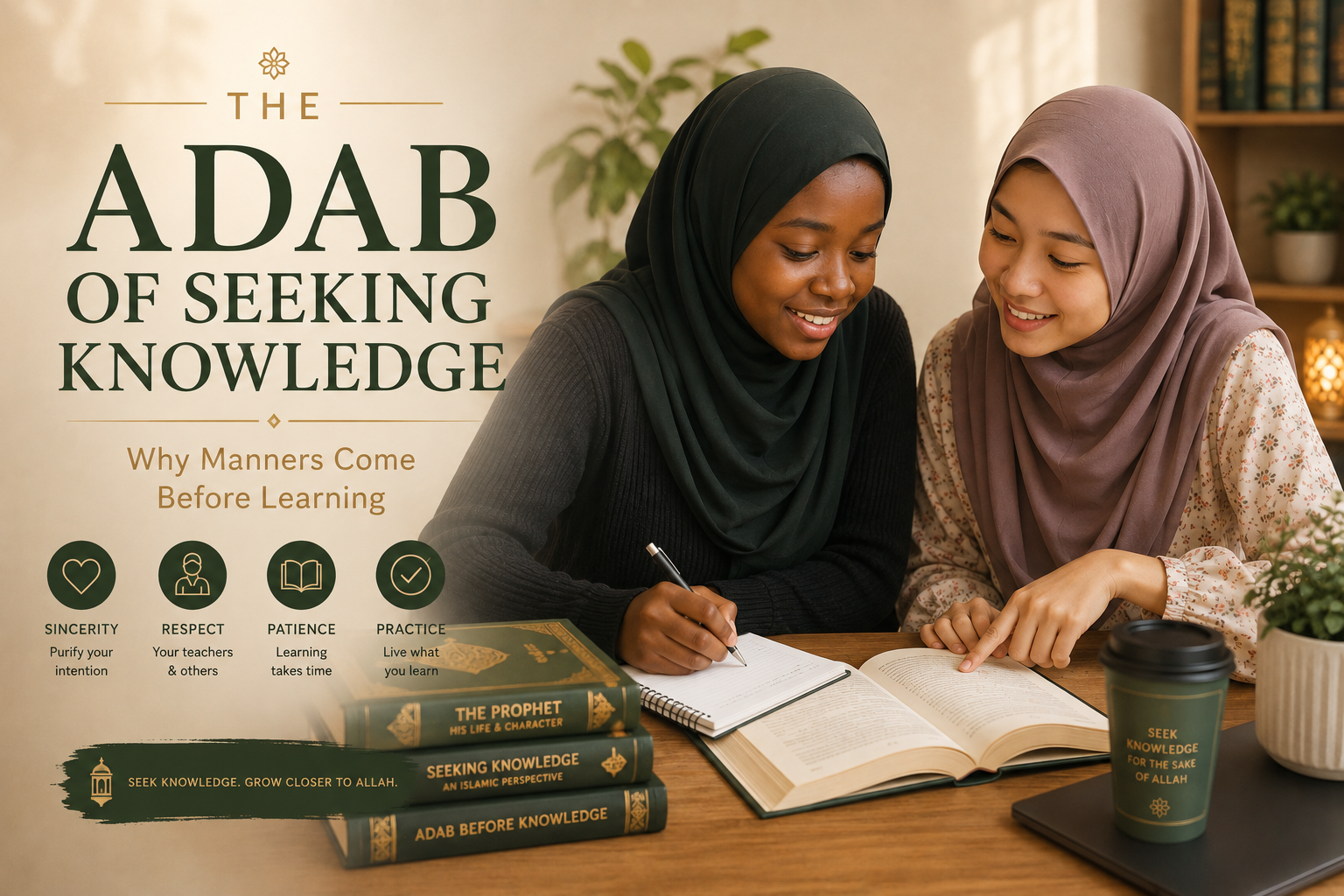
Islam doesn’t teach us simply to collect information. It teaches us to approach knowledge with sincerity, humility, patience and respect—and then to live by what we learn.
For young Muslims today, that matters more than ever. Islamic knowledge is only a tap away. But having information on your phone is not the same as having knowledge in your character.
The question isn’t only “What do I know?”
It’s also:
“What is this knowledge doing to me?”
What Is the Adab of Seeking Knowledge?
Adab can be understood as proper manners and conduct.
The adab of seeking knowledge includes how you approach learning, how you treat your teachers and other students, how carefully you speak about things you don’t understand, and what you do with the knowledge you gain.
Allah honours people of knowledge:
“Allah will raise those who have believed among you and those who were given knowledge, by degrees.”
But being given knowledge should make us more humble—not more arrogant.
If learning more about Islam makes you constantly look down on other Muslims, something is wrong.
Knowledge should improve your character along with your understanding.
1. Start With the Right Intention
Before asking what you want to learn, ask:
Why am I learning it?
Is it to understand your religion and become closer to Allah?
Or is it to win arguments? To prove someone wrong? To sound knowledgeable? To impress people?
Your intention won’t always be perfect. The important thing is to keep correcting it.
Remind yourself:
I’m learning so I can understand the truth, worship Allah better and become a better Muslim.
Islamic knowledge isn’t a performance.
2. Let Knowledge Make You Humble
One sign of growing knowledge is realizing how much you still don’t know.
Allah says:
“…and over every possessor of knowledge is one [more] knowing.”
Maybe you discover something your friend doesn’t know. Maybe you’ve studied an issue your parents never had the opportunity to study.
That doesn’t give you permission to become arrogant.
Knowledge should make you better at helping people, not better at humiliating them.
Sometimes one of the most knowledgeable things you can say is:
“I don’t know.”
3. Don’t Speak About Islam When You Don’t Know
Someone asks you an Islamic question.
You vaguely remember a TikTok or YouTube video about it.
You’re pretty sure you know the answer.
Should you answer?
Not necessarily.
Allah says:
“And do not pursue that of which you have no knowledge.”
There is no shame in saying:
“I’m not sure. Let me check.”
You aren’t expected to have an opinion about every Islamic issue.
Admitting that you don’t know isn’t weakness. It’s honesty.
4. Choose Who You Learn From Carefully
This is especially important online.
Your feed might show you a qualified scholar, a serious student of knowledge, an enthusiastic creator and someone with almost no Islamic training—all within five minutes.
They can look equally convincing.
But:
Followers aren’t qualifications.
Confidence isn’t scholarship.
A viral video isn’t automatically reliable evidence.
Before accepting something, ask:
Who is teaching this? What is their source? Are they qualified to explain this subject? Is a complicated issue being reduced to a dramatic thirty-second clip?
There is excellent Islamic education online.
Use it.
Just learn to distinguish good information from good presentation.
5. Listen Before You Argue
You see an Islamic opinion online that you disagree with.
You start typing.
Stop for a moment.
Ask yourself:
Am I trying to understand the truth—or am I trying to win?
Not every disagreement needs your comment.
Sometimes scholars genuinely differ. Sometimes you’ve misunderstood what somebody meant. Sometimes you haven’t studied enough to know why different opinions exist.
And sometimes an argument in a comment section simply isn’t worth having.
Seeking knowledge should teach you when to speak.
It should also teach you when not to speak.
6. Be Patient With Learning
A sixty-second video can teach you something useful.
It cannot teach you everything.
Real knowledge takes time.
The Prophet ﷺ taught that whoever follows a path seeking knowledge, Allah makes a path to Paradise easier for them. This is authentically reported from Abu Hurairah in Sahih Muslim 2699a.Want to see what dedication to knowledge can look like? Read our article on Why Seeking Knowledge is an Obligation in Islam: Lessons from Abu Hurairah.
Notice the word path.
Learning is a journey.
You ask questions. You forget things. You review them. You discover that something you thought was simple is actually more complicated.
That’s normal.
You don’t need to know everything today.
You just need to keep learning.
7. Put Your Knowledge Into Practice
This may be the most important test.
You can study the importance of prayer and still delay your salah.
You can learn that backbiting is wrong and then join in when your friends start talking about someone.
You can read about patience and then lose your temper with your family.
Knowledge is supposed to change something.
The Prophet ﷺ praised the person whom Allah gives wisdom and who acts according to it and teaches it to others, as authentically narrated by Abdullah ibn Mas’ud in Sahih al-Bukhari 73.
So whenever you learn something important, ask:
“What am I going to do differently now?”
Learn about kindness to parents? Improve one interaction with yours.
Learn about salah? Protect your next prayer.
Learn about controlling anger? Practise it during your next argument.
Knowledge becomes powerful when it leaves the screen and enters your life.
8. Learn Islam Online Without Losing Your Adab
Your generation has access to Islamic knowledge previous generations could never have imagined.
Use that opportunity wisely.
Check before sharing. A nice graphic saying “The Prophet ﷺ said” doesn’t automatically make the hadith authentic.
Don’t learn everything from clips. Short content can introduce a subject. Use it as a doorway to deeper learning.
Don’t confuse popularity with authority. Algorithms reward attention. Islamic scholarship requires knowledge.
Don’t publicly correct people just to embarrass them. If correction is needed, think about whether kindness or privacy would be better.
Don’t join every Islamic controversy. You don’t need an opinion on everything happening online.
And most importantly:
Actually study.
Saving 200 Islamic posts isn’t the same as studying 200 lessons.
Choose something useful. Learn it properly. Take notes. Ask questions. Apply it.
A Simple Adab Checklist
The next time you’re learning something about Islam, remember these seven questions:
- Why am I learning this?
- Is my source trustworthy?
- Have I understood it properly?
- Can I admit when I don’t know?
- Am I treating other people respectfully?
- Do I really need to argue about this?
- What will I change because I’ve learned it?
You don’t have to become a scholar overnight.
You just need to become a better student.
Knowledge Should Change You
Seeking knowledge is one of the most beautiful journeys a young Muslim can begin.
But don’t measure your progress only by how many books you’ve read, lectures you’ve watched or facts you’ve memorized.
Look at your character too.
Learn more—and become humbler.
Understand more—and become more patient.
Discover evidence—and become more careful with your words.
Learn what Allah loves—and try harder to live it.
The goal isn’t to become the person who knows the most Islamic facts in the room.
The goal is to seek beneficial knowledge that brings you closer to Allah and makes you a better Muslim.
And that is what the adab of seeking knowledge is ultimately about.
Sources
Qur’an
Hadith
- Sahih Muslim 2699a, narrated by Abu Hurairah رضي الله عنه — on taking a path in search of knowledge. The reference is verified in Sahih Muslim, Book 48, Hadith 48.
- Sahih al-Bukhari 73, narrated by Abdullah ibn Mas’ud رضي الله عنه — on the person given wisdom who acts according to it and teaches it. The reference is verified in Sahih al-Bukhari, Book 3, Hadith 15.