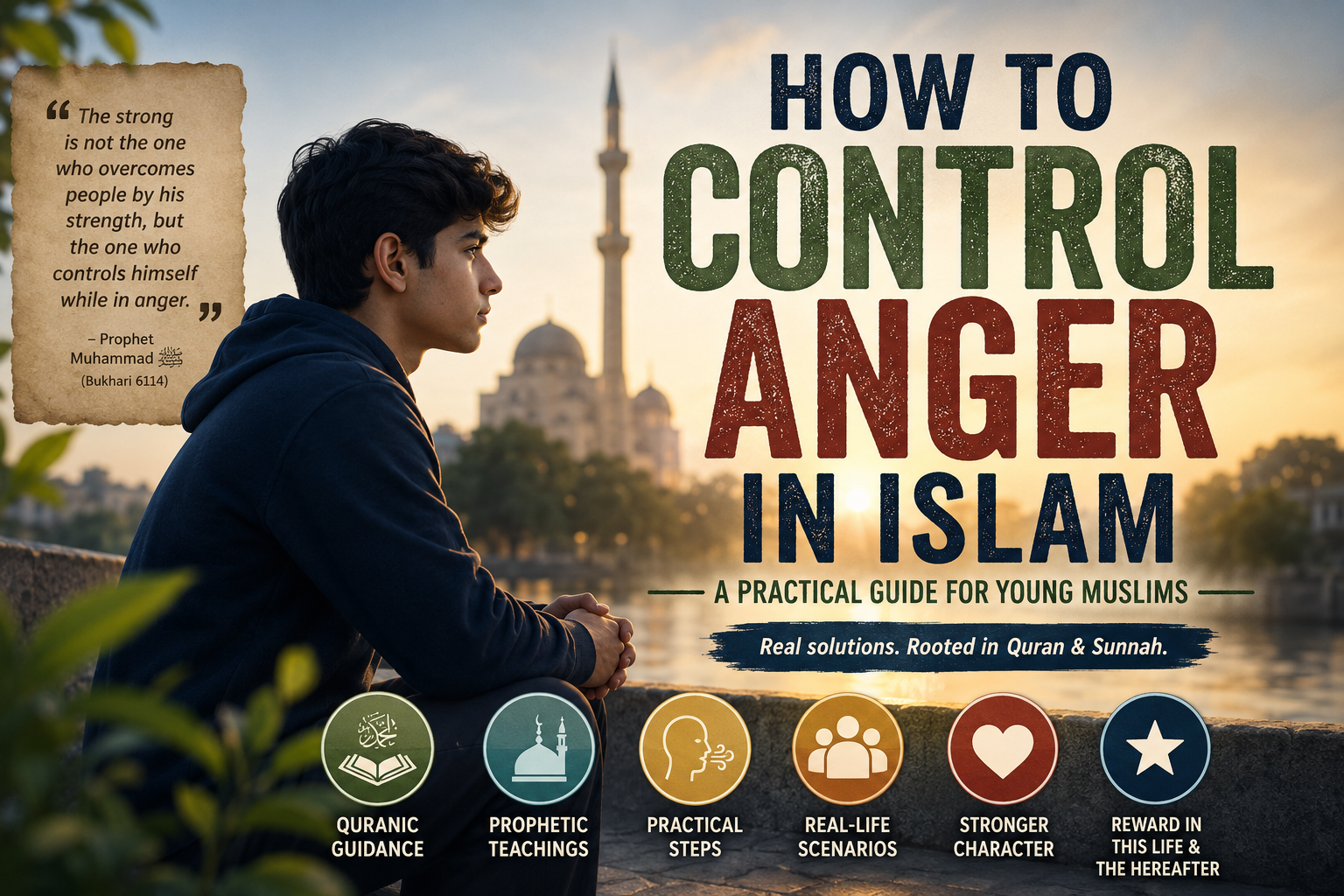
If you’re trying to learn how to control anger in Islam, start here. Maybe someone disrespected you online, your sibling said something hurtful, or you got blamed for something you didn’t do. Maybe you’re sitting in class, fuming at an unfair comment from someone in your group chat, or you just lost a gaming match to someone who was being toxic. Your face feels hot. Your chest is tight. You can feel the urge to say something sharp, to fire back, to hurt them the way they hurt you.
The question isn’t whether you’ll ever feel this way—you will. The real question is: what do you do when anger rises?
Islam doesn’t tell you that anger is sinful. Islam doesn’t expect you to be a robot. But Islam does teach you something deeper: that real strength is not about what you do in the moment of rage. Real strength is about what you choose to do despite the rage.
This guide shows you how.
Why Controlling Anger Matters — Especially for You
Anger is normal. You were made with emotions, and anger is one of them. That’s not a flaw. That’s being human. But uncontrolled anger is different—and it’s destructive.
When you let anger take over, you say things you can’t unsay. You damage friendships that matter. You hurt people who care about you. You hurt yourself: your reputation, your peace of mind, your character. A moment of rage can take years to recover from.
This is why the Prophet ﷺ gave this advice to someone asking for guidance: “Do not get angry.” He repeated it three times. The man kept asking for more guidance, and each time, the answer was the same. The repetition shows how seriously the Prophet ﷺ treated the danger of uncontrolled anger. The lesson is not that a Muslim should never feel anger, but that we should learn not to let anger control our words and actions.
That doesn’t mean suppressing your feelings. It means understanding them, and channeling them wisely.
What Islam Actually Says About Anger
The Quran addresses anger directly. Allah describes those He loves in these terms:
“Who spend [in the cause of Allah] during ease and hardship and who restrain anger and who pardon the people – and Allah loves the doers of good.” (Quran 3:134)
Notice what this verse pairs together: generosity, restraint, and forgiveness. These are not separate virtues. They’re interconnected. When you restrain your anger, you’re not being weak—you’re being generous with mercy. You’re choosing not to harm someone even when you could.
But here’s something crucial: feeling anger is not the same as acting wrongly because of anger.
Islam recognizes the difference. You can be angry and still choose your words carefully. You can feel wronged and still treat the other person with dignity. You can be upset and still think before you speak. The sin isn’t in the emotion; it’s in what you do with it.
A common misconception is that good Muslims don’t get angry. But that’s not Islamic teaching. Your emotions are part of being human. What matters is whether you let them drive you toward injustice or cruelty.
The True Measure of Strength in Islam
When people think of strength, they often picture someone who can intimidate others, who doesn’t back down, who fights back hard. But Islam redefines strength completely.
The Prophet ﷺ said:
“The strong is not the one who overcomes the people by his strength, but the strong is the one who controls himself while in anger.” (Sahih Al-Bukhari 6114, Sahih Muslim 2609)
Read that again. In Islam, true strength is self-control.
This contradicts what you see everywhere. Social media celebrates the person who shoots back a perfect insult. Video games reward aggression. Movies make the tough guy look powerful. But Islamic strength is quiet. It’s the person who’s provoked and chooses silence. It’s the person who could retaliate and chooses mercy instead. It’s you, walking away from a heated argument even when your adrenaline is screaming at you to fight.
When you control your anger, you’re demonstrating power—not over others, but over yourself. That’s the hardest kind of power to achieve. That’s why Islam honors it.
Why Anger Can Feel So Powerful When You’re Young
Anger can feel especially powerful when you’re young. You’re still figuring out who you are, what you believe, and how you fit into the world. Social acceptance matters deeply. So when someone disrespects you, it doesn’t just feel like a moment—it feels like an attack on who you are.
That’s real. Your feelings are valid.
But here’s also what’s true: you have more capacity for wisdom than you realize. The fact that you’re reading this, seeking to understand anger rather than just act on it, shows that. That capacity—to pause, to reflect, to choose—grows stronger every time you use it.
What Controlling Anger Does NOT Mean
Before we go further, let’s be absolutely clear about what we’re not saying.
Controlling your anger does not mean accepting abuse. If someone is harassing you, bullying you, or treating you with deliberate cruelty, controlling your anger doesn’t mean staying silent forever. It means responding wisely rather than reactively. It might mean telling an adult, documenting what happened, or removing yourself from that situation. These are all acts of strength, not weakness.
Controlling your anger does not mean staying quiet on injustice. If something is genuinely wrong—if someone is being treated unfairly, if rules are being applied unjustly, if harm is being done—you can and should speak up. Islam calls you to stand for justice. But you can do it without losing your temper, without being cruel, without stooping to the level of the person who’s in the wrong.
Controlling your anger does not mean never expressing your feelings. You can tell someone firmly that they hurt you. You can say no. You can set boundaries. You can disagree. None of that requires anger or cruelty.
Controlling your anger does not make you a doormat. Some of the most powerful people in Islamic history were known for their restraint precisely because they used it strategically. They didn’t react to every provocation. They chose their battles. That’s wisdom, not weakness.
Does Islam Teach That Anger Is Always Wrong?
No. The Quran also says:
“Repel [evil] by that which is better; and thereupon the one whom between you and him is enmity [will become] as though he was a devoted friend.” (Quran 41:34)
Notice: Islam acknowledges that evil exists. Enmity exists. You will encounter situations where someone is genuinely in the wrong. The question is how you respond.
When your anger is about standing up for yourself or others against real wrongdoing, that’s different from anger born from ego, hurt feelings, or the desire to make someone suffer. Know the difference. Ask yourself honestly: Am I angry because something is genuinely unjust, or am I angry because my pride is hurt? Often it’s both. That’s okay. But be honest about it.
Even when your anger is justified, your response still matters. You can address injustice firmly and clearly without being cruel or unjust in return.
How to Control Anger in Islam: An Islamic Action Plan
The Sunnah gives us practical, immediate steps.
In the first moment, when anger is rising:
Seek refuge in Allah. When you feel anger starting to take control, say: “A’udhu Billahi Minash-Shaytanir-Rajim” (I seek refuge in Allah from the accursed Satan). The Prophet ﷺ specifically taught seeking refuge in Allah during a moment of anger. It turns your attention toward Allah at the very moment your emotions are pushing you toward an impulsive reaction. This isn’t passive—it’s an active choice to redirect your focus.
Change your position. The Prophet ﷺ gave this practical advice: if you are standing and feel anger rising, sit down. If the anger remains even after sitting, lie down. Changing position can also create a physical pause between the feeling of anger and your reaction, giving you space to regain control.
Create distance if needed. If the situation is escalating, step away from the conversation, put down your phone, or give yourself time before responding. Some people need to go for a walk, splash water on their face, or do something physical. Find what works for you. The goal is to remove yourself from the moment so your emotions don’t dictate your next move.
Over time, as you practice:
Remember Allah. When anger rises, remind yourself that Allah sees your response. Ask yourself what response would be most pleasing to Him—not what would feel most satisfying for the next ten seconds. That shift in perspective can completely change how you act.
Recall the consequences. Think about what happens when you lose control. Think about the last time you said something in anger that you regretted. Think about how it felt after. That memory is your teacher.
When you’re ready to communicate:
Pause before you respond. Don’t fire off a message immediately. Don’t say the first thing that comes to your mind. Wait. Sleep on it if you can. The difference between a message you send in anger and one you send after calming down is usually the difference between damage and resolution.
Lower your voice. The Quran mentions this: “And be moderate in your pace and lower your voice” (Quran 31:19). A raised voice escalates conflict. A calm voice, even when you’re saying something firm, keeps the door open for understanding.
Choose your words carefully. Say what needs to be said, but without cruelty. You can be honest without being harsh. You can set a boundary without attacking someone’s character.
Apologize if you’ve wronged someone. If your anger made you say something hurtful, own it. A genuine apology is powerful. It shows strength, not weakness. It’s also Islamic—forgiveness and reconciliation are deeply valued in our tradition.
Then address the real issue. Once you’ve calmed down and communicated respectfully, you can discuss what actually happened. Often, when we remove anger from the conversation, solutions become possible.
Real-Life Scenarios Young Muslims Face
Let’s get specific, because anger doesn’t happen in the abstract.
An argument with your parents: They said something about your future that you disagree with, or they made a rule you think is unfair. You feel disrespected. In that moment, anger wants you to be disrespectful back. Islam emphasizes kindness to parents even when you disagree. Controlling your anger means expressing your view respectfully, listening without insults or shouting, and choosing good manners even when you strongly disagree.
A conflict with a friend: They did something that hurt you—talked about you behind your back, said something hurtful as a “joke,” or didn’t include you in something. Anger makes you want to respond with equal hurt. Controlling anger means: tell them honestly that you’re hurt, listen to their side, and decide if the friendship is worth fighting for or if it needs to change.
Online harassment or group chat drama: Someone posts something mean about you, or the group turns on someone and you see it happening in real time. Anger makes you want to respond with a cutting comment, to humiliate them back. Controlling anger means: don’t engage in the moment, screenshot it if needed, talk to a trusted adult, and decide if responding will actually help or just make things worse.
Bullying or insults at school: Someone says something dehumanizing. It’s personal. It’s cruel. Anger is absolutely appropriate—but the question is what you do with it. Don’t turn an insult into a physical confrontation. If you are in immediate danger, prioritize getting to safety and seeking help from a trusted adult or appropriate authority.
Gaming frustration: You’re playing with friends and someone is being toxic, blaming you for losses, or being disrespectful. Anger makes you want to respond with equally toxic behavior. Controlling anger here means: mute them if you can, focus on playing your best, or step away from the game entirely. Gaming is supposed to be fun. If it’s making you angry, it’s not worth it.
When authority figures are unfair: A teacher grades you unfairly, a coach benches you despite good performance, or a manager at your part-time job makes an unreasonable decision. The anger is justified. But responding angrily will only make things worse. Controlling anger means: take time to calm down, then address it respectfully. Ask for clarification. Ask for a chance to discuss it. Document the situation if needed. Go to a higher authority if the unfairness continues.
In each of these situations, controlling your anger does not mean accepting injustice. It means responding in a way that actually solves the problem instead of making it worse.
The Prophet Muhammad ﷺ as Your Model for Anger Control
The Prophet ﷺ taught us to seek refuge in Allah when anger rises. He taught us to change our position when we feel rage overtaking us. He taught us to remain silent rather than speak words we will regret. These teachings weren’t abstract philosophy—they were practical wisdom born from his own example of complete self-control.
The Prophet ﷺ’s instruction to us is not to avoid confronting problems or injustice. It is to face them with clarity, justice, and compassion rather than impulse and emotion. When he taught us these methods, he was showing us that the strongest person is not the one who reacts fastest, but the one who chooses most wisely.
For a deeper look at the character young Muslims can learn from, read The Prophet Muhammad ﷺ: The Ultimate Role Model for Muslim Youth on this site. It explores how his example can guide us toward our best selves.
The Hidden Reward of Controlling Your Anger
Why do this work? Why choose restraint when you could choose revenge?
The Quran gives the answer: “Allah loves the doers of good.” (Quran 3:134)
When you restrain your anger, you’re not just avoiding harm—you’re doing something positive. You’re choosing mercy. You’re protecting a relationship. You’re showing someone that they’re worth more than your momentary rage. That matters. And Allah sees it.
Beyond that, controlling your anger transforms your actual life. It protects your friendships. It improves your reputation. It gives you peace of mind. It makes you someone people trust and respect. These aren’t just spiritual rewards—they’re real, practical benefits that come from choosing wisdom over impulse.
There’s also a deeper spiritual dimension. Every time you control your anger, you’re strengthening your soul. You’re building character. You’re becoming the kind of person who can lead, who can be trusted in difficult moments, who can be a source of calm rather than chaos. That’s not a small thing.
A Practical Challenge for You
The next time anger rises, remember: you don’t have to win the argument. You don’t have to have the last word. You don’t have to prove that nobody can disrespect you.
Sometimes the strongest thing you can do is pause, remember Allah, and choose a response you won’t regret tomorrow.
You may not control what other people say to you. You may not control how they behave. But with Allah’s help, you can learn to control what you do next.
And that is the kind of strength the Prophet ﷺ taught us to build.
If you’re struggling with anger that regularly feels out of control or puts you or others at risk, speak to a trusted adult, parent, teacher, counselor, imam, or another qualified professional. Seeking help when you need it is part of taking responsibility for yourself.
Sources
Qur’an
- Quran 3:134 (Sahih International translation)
- Quran 31:19 (Sahih International translation)
- Quran 41:34 (Sahih International translation)
Hadith
- Sahih Al-Bukhari 6114 — “The strong is not the one who overcomes the people by his strength, but the strong is the one who controls himself while in anger.”
- Sahih Muslim 2609 — Same hadith as above
- Sahih Al-Bukhari 6115 & Sahih Muslim 2610 — Sulaiman ibn Surad: The Prophet taught seeking refuge in Allah during anger
- Sunan Abu Dawud 4782 — Abu Dharr: Changing position when angry (sit down if standing, lie down if anger persists)
- Sahih Al-Bukhari 6116 — Abu Huraira: “Do not get angry” (advice repeated)