Sometimes it feels like everyone else has something you don’t.
Someone has better clothes. Better grades. More friends. A nicer phone. More confidence. Their family seems happier. Their life on social media looks almost perfect.
And without realizing it, you can spend so much time looking at what other people have that you stop noticing what Allah has already given you.
Islam gives us another way to live.
It’s called shukr — gratitude.
Gratitude in Islam doesn’t mean pretending your problems don’t exist. It doesn’t mean you have to be happy every second. And it doesn’t mean wanting to improve your life is wrong.
It means learning to recognize Allah’s blessings even while you’re still working through difficulties.
And that can change the way you see your life.
What Does Shukr Mean in Islam?
We often translate shukr as “gratitude” or “thankfulness.”
But Islamic gratitude goes deeper than simply saying Alhamdulillah when something good happens.
Yaqeen Institute’s research on Qur’anic shukr explains gratitude as something that involves both our inner recognition of Allah’s blessings and the way we respond to those blessings. Its study draws on classical Islamic scholarship to explore gratitude as something expressed through the heart, tongue, and actions.
Think of it simply:
Your heart recognizes the blessing.
Your tongue thanks Allah for it.
Your actions use that blessing well.
If Allah gives you knowledge, gratitude means using it well.
If Allah gives you supportive parents, teachers, or friends, gratitude means appreciating them.
If Allah gives you abilities, gratitude means developing them rather than wasting them.
Shukr isn’t just something you say.
It’s something you live.
Allah Promises More to Those Who Are Grateful
Allah gives us an extraordinary promise in the Qur’an:
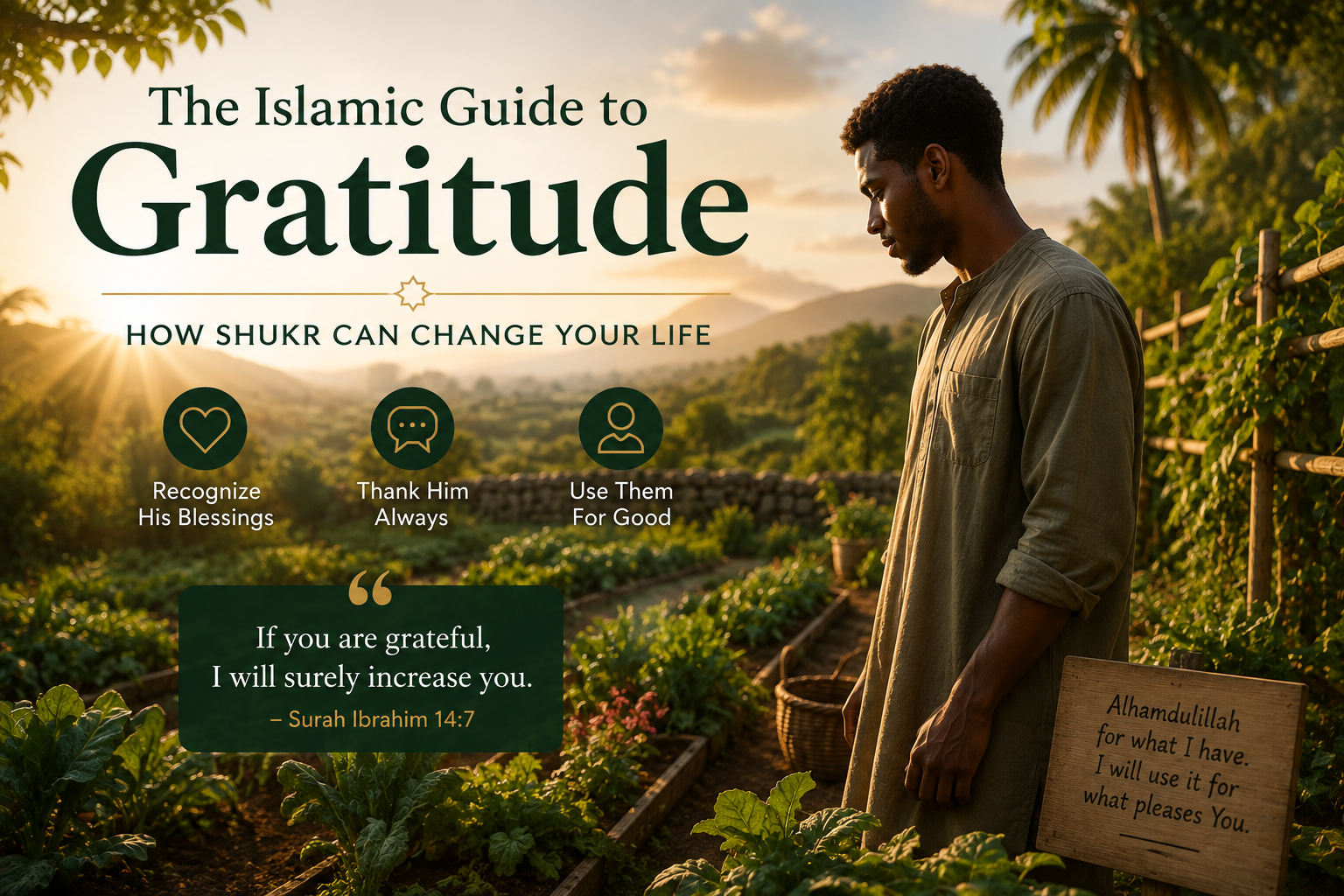
“If you are grateful, I will surely increase you.”
Notice that Allah doesn’t tell us to wait until life is perfect before becoming grateful.
Gratitude begins with what you have right now.
Maybe you don’t have everything you want.
But what do you already have that you rarely think about?
Your eyesight. A meal. Someone who cares about you. The ability to learn. Another day to make things right. Your iman.
Even being able to turn back to Allah is itself a blessing.
The problem is that blessings can become almost invisible when we experience them every day.
Shukr teaches us to notice them again.
The Social Media Comparison Trap
This matters especially when you’re young.
You can open your phone and, within minutes, see hundreds of things you don’t have.
Someone is travelling.
Someone got accepted into a great university.
Someone looks amazing.
Someone’s post gets thousands of likes.
Someone seems more successful than you.
After enough scrolling, an ordinary life can start feeling like a disappointing one.
But you’re comparing your whole life with carefully selected moments from somebody else’s.
Shukr interrupts that cycle.
Instead of constantly asking:
“Why don’t I have what they have?”
you begin asking:
“What has Allah already placed in my life?”
That doesn’t kill ambition.
You can have goals. You can want to improve. You can work hard for something better.
Gratitude simply stops ambition from turning into constant dissatisfaction.
The Prophet ﷺ Turned Gratitude Into Action
One of the most powerful examples of gratitude comes from the Prophet Muhammad ﷺ.
Al-Mughirah ibn Shuʿbah رضي الله عنه reported that the Prophet ﷺ would stand in prayer until his feet became swollen. When asked about this devotion, he replied:
“Should I not be a thankful servant?”
— Sahih al-Bukhari 1130
The same meaning is authentically reported in Sahih Muslim 2819.
Think about that.
His gratitude wasn’t merely:
“Alhamdulillah.”
It became worship.
That teaches us something important.
Real gratitude eventually changes what we do.
For more on how the Prophet ﷺ can shape the way we live and develop our character, read The Prophet Muhammad ﷺ: The Ultimate Role Model for Youth.
Gratitude Doesn’t Mean Your Life Is Easy
This is important.
Being grateful does not mean pretending everything is okay when it isn’t.
You can be grateful and still be sad.
You can practise shukr while dealing with family problems.
You can say Alhamdulillah and still be disappointed about a grade.
You can appreciate what Allah has given you while working hard for something better.
Gratitude and struggle can exist at the same time.
The Qur’an itself describes servants of Allah who experienced enormous trials yet remained grateful.
Nuh عليه السلام is described as “a grateful servant” in Surah Al-Isra 17:3.
Ibrahim عليه السلام is described as grateful for Allah’s favors in Surah An-Nahl 16:120–121.
So don’t confuse gratitude with pretending.
Islam isn’t asking you to deny pain.
It’s teaching you not to let pain make you blind to every blessing that remains.
Three Simple Ways to Practise Shukr
Practising gratitude in Islam doesn’t require a complicated routine. Start with three simple habits.
Start with three simple habits.
1. Notice One Blessing Every Day
Before going to sleep, identify one specific blessing Allah gave you that day.
Not just:
“I’m grateful for everything.”
Be specific.
“Alhamdulillah for the friend who checked on me today.”
“Alhamdulillah I understood something difficult in class.”
“Alhamdulillah I got home safely.”
“Alhamdulillah for the food I ate.”
Training yourself to notice small blessings makes gratitude practical.
2. Say Alhamdulillah — and Mean It
We say Alhamdulillah often.
That’s beautiful.
But sometimes the words can become automatic.
Slow down occasionally.
When something good happens, actually recognize where the blessing came from.
Alhamdulillah.
All praise belongs to Allah.
Don’t just say it with your tongue.
Give yourself a moment to recognize the blessing with your heart.
3. Use the Blessing Well
This may be the most challenging part.
If Allah gave you intelligence, what are you doing with it?
If He gave you money, how do you spend it?
If He gave you influence, how do you treat people?
If He gave you a healthy body, how do you use it?
If He gave you Islamic knowledge, is that knowledge improving your character? Learning also comes with responsibility. Good manners and sincerity are part of how a Muslim approaches knowledge. Read: The Adab of Seeking Knowledge: Why Manners Come Before Learning
A blessing isn’t only something to enjoy.
It’s also something to use well.
Gratitude Includes Thanking People
There’s another side of gratitude that is easy to forget.
Thank people.
Your parents.
Your grandparents.
Your teacher.
Your sibling.
The friend who helped you.
The person at the masjid who always makes time for you.
The Prophet ﷺ taught that the person who does not thank people does not properly thank Allah. This is reported in Jamiʿ at-Tirmidhi 1955.
Sometimes gratitude can be as simple as sending someone a message:
“JazakAllahu khayran. I really appreciate what you did for me.”
Don’t wait until people are gone from your life to appreciate what they brought into it.
Try the 7-Day Shukr Challenge
Here’s a simple challenge you can try.
For the next seven days, before bed:
Name three things Allah gave you that day.
Try not to repeat the same three things every night.
Day one might be family, food and health.
By day five, you’ll have to look harder.
Maybe you’ll notice the teacher who explained something twice.
The rain.
A conversation with your mother.
Being able to make salah.
A mistake you learned from.
A quiet moment.
This isn’t a prescribed Sunnah practice. It’s simply a practical exercise to help you become more aware of the blessings already around you.
And that’s the point:
You’re training yourself to notice.
Because the blessings were often there all along.
Don’t Wait for More Before Saying Alhamdulillah
Gratitude in Islam teaches us that contentment doesn’t require us to stop growing or pursuing our goals. It’s easy to create conditions for happiness:
I’ll be happy when I get better grades.
When I have more money.
When I look different.
When I get into that school.
When people respect me.
There will always be another “when.”
Shukr teaches you something stronger:
Work for tomorrow without becoming blind to today.
Ask Allah for more.
Build your future.
Improve yourself.
Have goals.
But don’t spend your whole youth waiting for your life to become worthy of gratitude.
Look around.
There is something Allah has given you today that you once didn’t have, that someone else is praying for, or that you might not have noticed until now.
Recognize it.
Use it well.
Thank the people through whom Allah brings goodness into your life.
And thank Allah.
Alhamdulillah for what you have.
Alhamdulillah while you’re growing.
Alhamdulillah even while you’re waiting for what comes next.
Because shukr isn’t about having the perfect life.
It’s about learning to see Allah’s blessings in the life you already have.
Sources
Qur’an
- Surah Ibrahim 14:7 — Allah’s promise of increase for gratitude
- Surah Al-Baqarah 2:152 — remembering Allah and being grateful to Him
- Surah Luqman 31:12 — Luqman is given wisdom and instructed to be grateful to Allah
- Surah An-Nahl 16:120–121 — Ibrahim عليه السلام is described as grateful for Allah’s favors
- Surah Al-Isra 17:3 — Nuh عليه السلام is described as a grateful servant
Hadith
- Sahih al-Bukhari 1130 — al-Mughirah ibn Shuʿbah رضي الله عنه narrates the Prophet’s ﷺ long prayer and his response about being a thankful servant.
- Sahih Muslim 2819a–b — authentic parallel narration concerning the Prophet ﷺ being a grateful servant.
- Jamiʿ at-Tirmidhi 1955 — concerning gratitude to people.
Further reading and research
Dr. Tamer Desouky, The Art of Gratitude: Qur’anic Themes on Shukr, Yaqeen Institute for Islamic Research. The paper examines how shukr appears throughout the Qur’an and how gratitude can become a lived practice.
The Art of Gratitude: Qur’anic Themes on Shukr — Yaqeen Institute